
Transcript and description: Scripture, history and sources
A short motion-graphics video. Every app screen in it is a screen recording of the GospelArc development build on its bundled content, made in the iOS Simulator by an automated UI test; the status bar (time 9:41, full signal, charged battery) is set for the recording and is not the device's real state. The study content in the app (journeys, history dossiers and timelines, Origins & Witnesses, connections and review questions) is machine-drafted, the app marks it as an editorial draft, and it awaits review by qualified historians, theologians and editors. The Bible text is the World English Bible (Catholic book order). Nothing is drawn onto the app screens or changed in them after recording: any note, route, answer or search text in them was entered in the app by the UI test. Titles, captions and callouts stay beside or behind the phone. There is no music and no voice-over.
How it was edited
- Each recording is cut to the part the UI test marked; the app launch before it is left out.
- Pauses where nothing moves are shortened; frames are never reordered.
- Between some shots, part of a recording is left out.
- Some motion is sped up, at most 1.6×.
- Transitions between shots.
- Callouts with icons beside the phone name what the screen shows.
On screen
- 0:00“Scripture, history and the sources” “A Bible study app, in development.” The GospelArc app icon and the title of the video.
- 0:02Bible journeys — “Stories through complete passages” “The Road to Emmaus, from the Atlas” The Road to Emmaus opened from the Journey Atlas
- 0:05History & Providence — “Two clocks, kept apart” “Reported date, oldest written record” the Fátima journey's two-clock timeline
- 0:09Origins & Witnesses — “The first Christians, year by year” “The Expansion Atlas date slider” the Expansion Atlas date slider dragged from 91 CE to 170 CE and the map following it
- 0:12Connections — “Links between passages, drawn” “Each link says what kind it is” the Connections graph dragged gently
- 0:15Scripture — “Search the Bible text” “A keyword and the verse it finds” a keyword search in the Scripture library and its results
- 0:19GospelArc — “Scripture, History & Sources” “In development · not yet on the App Store” gospelarc.com End card. Screen recordings from the development build · study content not yet reviewed. The study content is machine-drafted and awaits review by qualified historians, theologians and editors.
Shown next to the screen recordings (0:01–0:19): Screen recording from the development build · study content not yet reviewed

GospelArc Explore Scripture. Discover history. Connect the evidence.
GospelArc is a Bible study app for iPhone and iPad. It follows Bible stories through complete passages, and reads selected events of Christian history beside dated sources, saying what those sources do and do not establish.
In development · not yet on the App Store
There is no public beta, no release date and no price yet. All study content in the app is machine-drafted and awaits review by qualified historians, theologians and editors before release; until then the app marks it “Editorial draft”.
Description: Bible journeys: The Road to Emmaus
Screen recording of the development build, no sound: The Road to Emmaus opened from the Journey Atlas and its overview scrolled; the first step opens Luke 24:1–12, marked at the start of its chapter with the next verses below it, scrolled down in short glides; “Mark Complete and Go On” then opens the second step.
The core principle
Evidence and interpretation, kept apart
GospelArc separates what a source documents from what readers, scholars or the Church draw from it. Each claim card in its history journeys carries one of four source labels, shown as a symbol and words, never by colour alone. A Compare Claims row can draw on several kinds of source, so that screen lists the four labels once, as a key above its rows. In the app, a tap on a label shows what it means.
The four source labels, as the app defines them
-
Historical attestation
A source supports a narrowly specified fact. It does not independently prove every event in a Gospel, the resurrection, or divine agency.
-
Archaeological context
A material artifact confirms a named official, place, custom or setting. By itself it does not confirm a miracle, a speech, or a claim about supernatural causes.
-
Reported testimony / private revelation
What a person or community reported, when it was first recorded, and by whom. Testimony may be historically attested even though a supernatural explanation cannot be demonstrated.
-
Catholic interpretation / biblical parallel
An explicitly attributed theological reflection. An analogy is not direct fulfilment, and an event outside the Bible is not in the Bible.
What this does NOT establish
Catholic reflection is labelled and attributed; it is not presented as historical fact. A study perspective setting changes which panels start open. Nothing is removed, and “What this does NOT establish” is always shown.

In the development build
What GospelArc does
Every feature below exists in the current development build, which has run in simulators and in automated tests on one iPhone. The numbers count drafted content in that build, computed from its content files on every update of this site. None of that content has had human review yet.
-
Bible journeys through complete passages
Guided journeys through Bible stories. Each stop keeps its chapter close by and says why the next stop follows. The text is the World English Bible in Catholic book order: 73 books stored in the app, with its wording unedited. A 66-book option filters the same edition.
Drafted in the current development build 12 Bible journeys · 121 steps
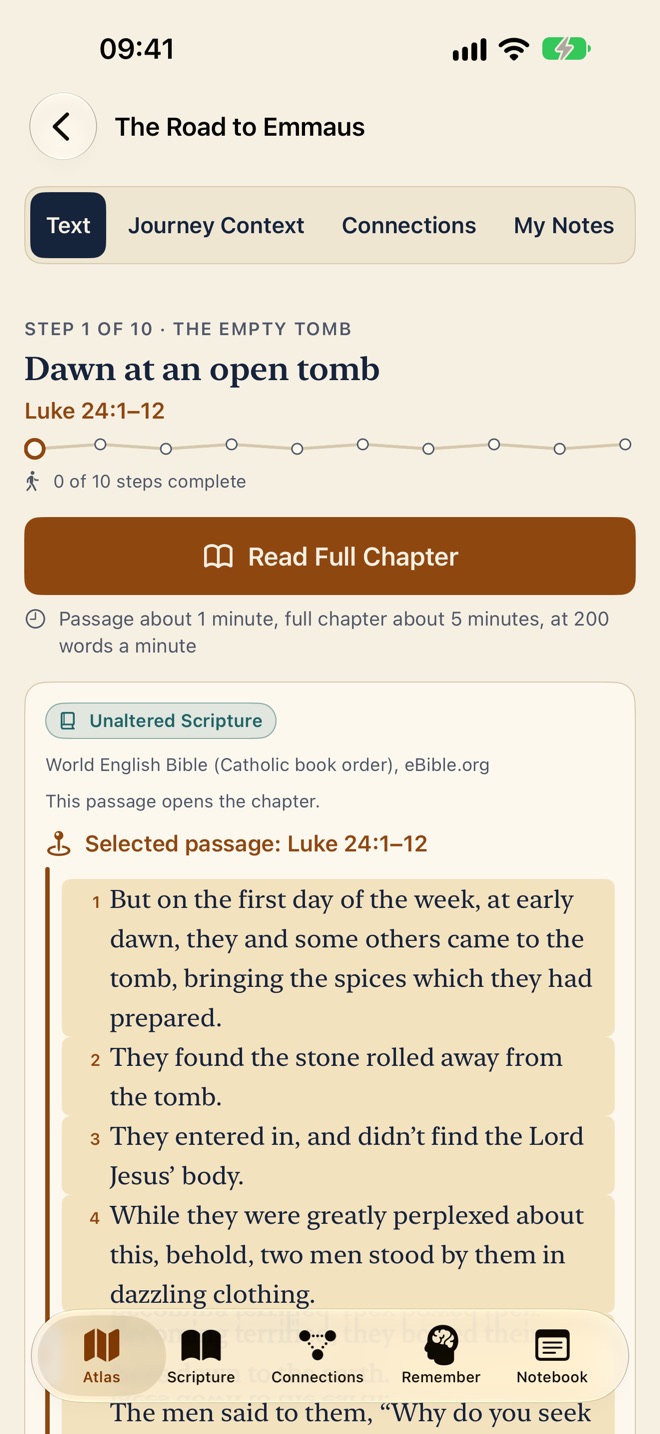
Read complete passages in their chapter -
History & Providence
History journeys in four groups: Apparitions & Revelations, Providence in History, Saints & Witnesses, and Eucharistic Traditions. Their evidence dossiers show who wrote a source, when, and whether the author was an eyewitness. The Event Timeline keeps two clocks: when something is reported to have happened, and when the oldest dated source was written. The two dates are never merged.
Drafted in the current development build 23 history journeys · 145 evidence dossiers
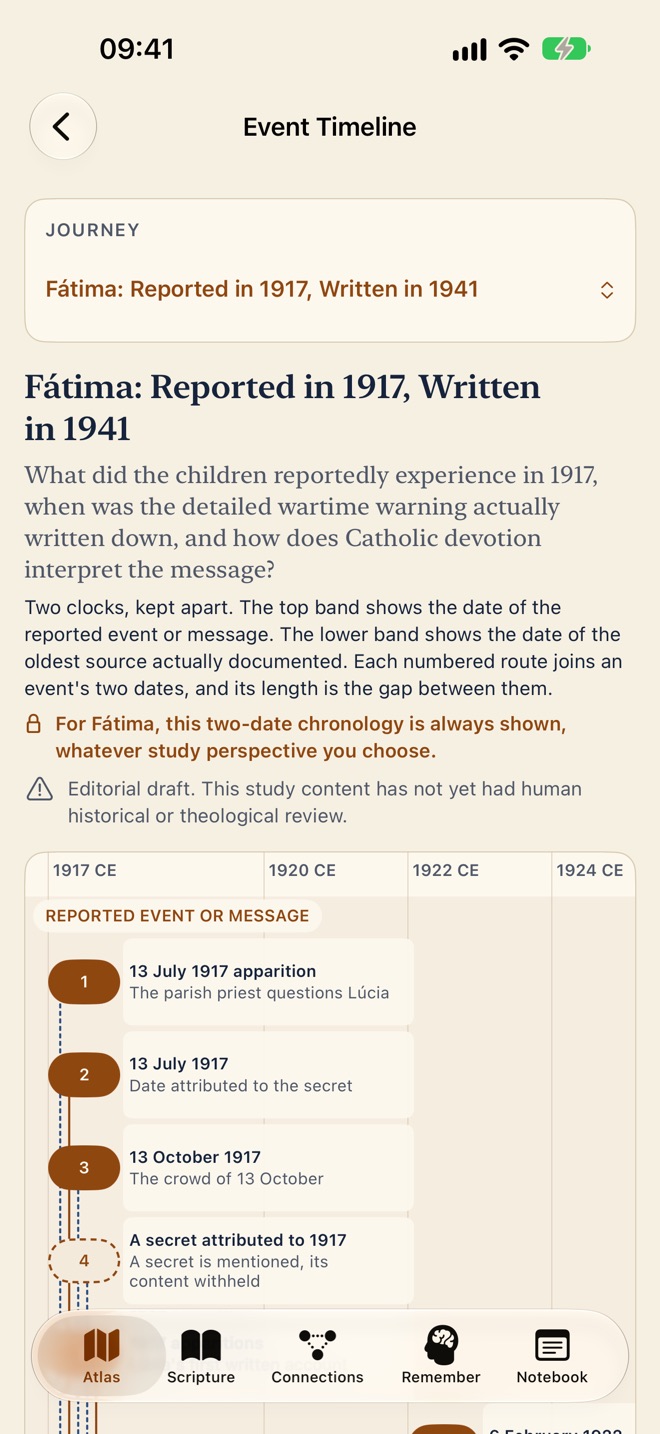
Two clocks: reported date, documented date -
Origins & Witnesses
A hub inside History & Providence on the first Christians, from Jerusalem to Gaul. Its tools are an Expansion Atlas (a hand-drawn schematic map with a date slider and a full list), a Three-Clock Timeline, miracle accounts labelled by kind of report with none presented as verified, “Why did Christianity spread?”, a persecution and resilience lens, witness chains and source-literacy challenges.
Drafted in the current development build 4 subroutes · 44 waypoints · 12 miracle accounts
Its subroutes are not counted as journeys. The Provençal tradition is a separate map layer, off until you choose it and labelled as later tradition. The map is drawn by hand from approximate coordinates and is not for measurement.

Screen recording from the development build · study content not yet reviewed Description: Origins & Witnesses: the Expansion Atlas
Screen recording of the development build, no sound: the Origins & Witnesses hub opened from History & Providence and scrolled, then its Expansion Atlas, a hand-drawn schematic map. Its date slider, from 30 CE to 200 CE, jumps from “All dates” to 91 CE, then is dragged slowly to 170 CE; the heading above it changes from “All dates” to “Set up to” the chosen year, and the map follows it.
-
The Connections graph
Links between Bible passages, as a graph or a list. Each link says what kind it is: quotation, explicit reference, shared person, shared event or recurring theme. Recurring themes are labelled as interpretation.
Drafted in the current development build 573 links · 994 passages in 61 books

Screen recording from the development build · study content not yet reviewed Description: The Connections graph
Screen recording of the development build, no sound: the Connections tab with its graph of links around Luke 24:1–53, dragged gently one way and partway back; one link is then opened from the graph, Luke 24:28–29 and Acts 16:14–15. It shows its relationship type, “Recurring theme / editorial interpretation”, its certainty, “Editorial interpretation”, and the panel “What this does NOT establish”, then the passage behind this reading, Acts 16:14–15, and why the link is drawn, labelled editorial commentary.
-
Remember: active recall
Spaced review of what you read: drafted questions on the Bible journeys, the history journeys and Origins & Witnesses, where you fill in a blank, choose an answer, connect a reference, put items in order or sort them into categories. The app also builds date and sorting exercises from the history journeys’ timelines and claims; those are not in the count below. On a fill-in-the-blank verse you can try an answer before you reveal the source, and items come back on their own schedule. Reminders are optional, local and off by default.
Drafted in the current development build 451 recall questions

Screen recording from the development build · study content not yet reviewed Description: Remember: one review question
Screen recording of the development build, no sound: the Remember tab and a review session started; its first question is answered and checked, and the result shows whether the answer was right, an explanation labelled as editorial commentary, and when the question comes back for review.
-
Notebook and private routes
Notes, highlights and bookmarks on any passage, and routes of your own that mix Bible passages and historical sources. A route exports as JSON, Markdown or PDF, and a JSON route can be imported again. A subroute of Origins & Witnesses can become a private route.

Screen recording from the development build · study content not yet reviewed Description: Notebook: a note and a route of your own
Screen recording of the development build, no sound: in the reading studio’s My Notes tab, a note is typed on Luke 24:1–12 and saved under the passage; then the Notebook and My Routes, where a new route named “The Emmaus road” is created and Luke 24:13–35 is added to it as a step.
-
Scripture: read and search
The Bible text itself: the World English Bible in Catholic book order, stored in the app. Open a book to its chapters and read a whole chapter, or search by reference or keyword; each result opens inside its full chapter. The Bible Text & Licenses screen sets out what was changed for display, what was kept and what was left out: the edition’s preface, its book title lines, its cross-reference notes and four footnotes placed on headings. No word of any verse is added, dropped or edited.
-
Kept on your device
No account, no analytics, no advertising and no third-party SDKs. Notes, highlights, bookmarks and progress stay on your device; your own device backup may include them. In Settings you can export a copy of your data or delete it.

A look at the development build
Captures from the app’s UI tests on an iPhone simulator, 1 November 2026. Where a dark capture exists, it follows your device’s dark mode. Several of them show the “Editorial draft” note that the app puts on its study screens.
-
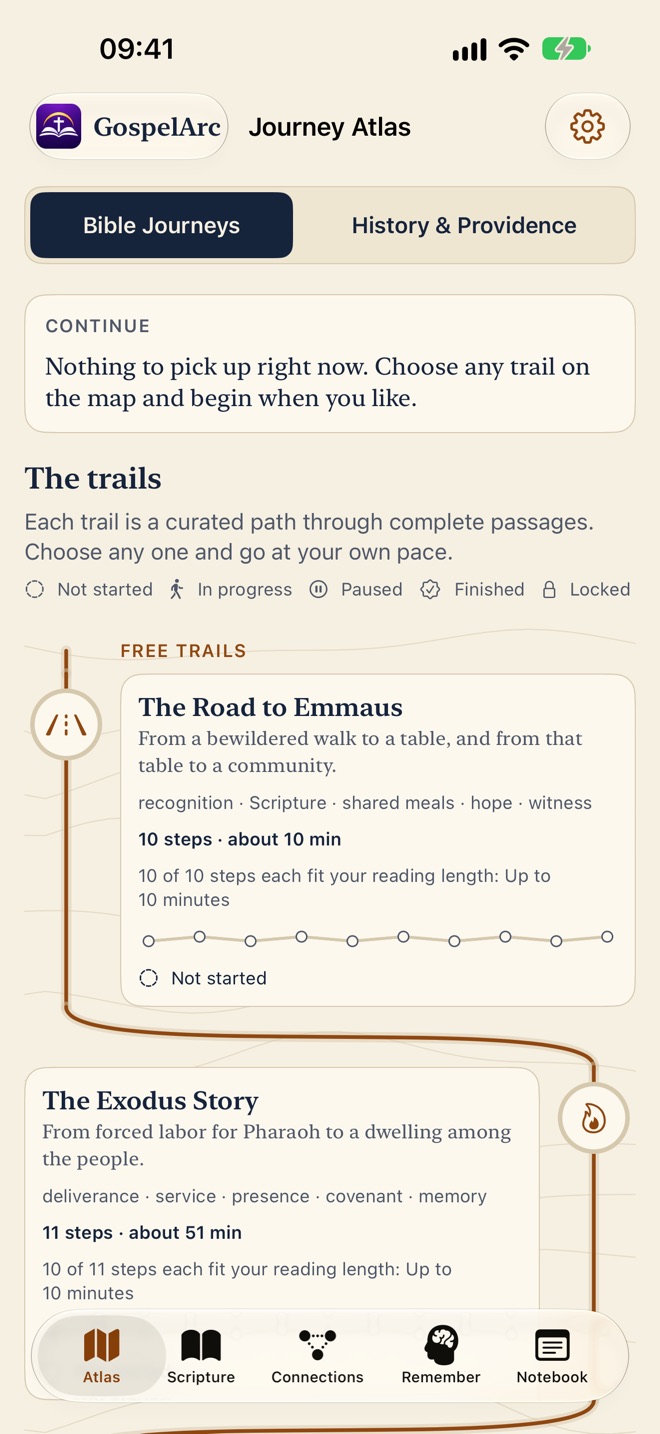
Follow guided Bible journeys -
Read complete passages in their chapter -
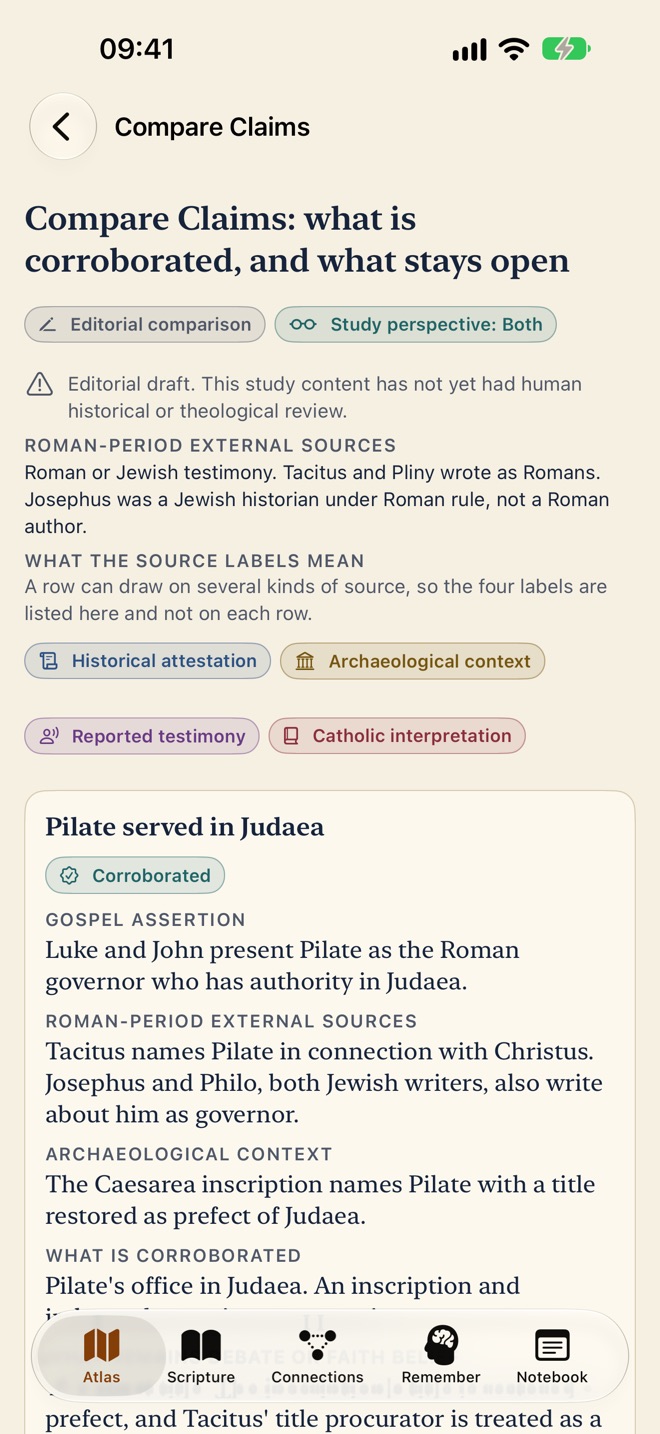
Compare Claims: the four source labels as a key -
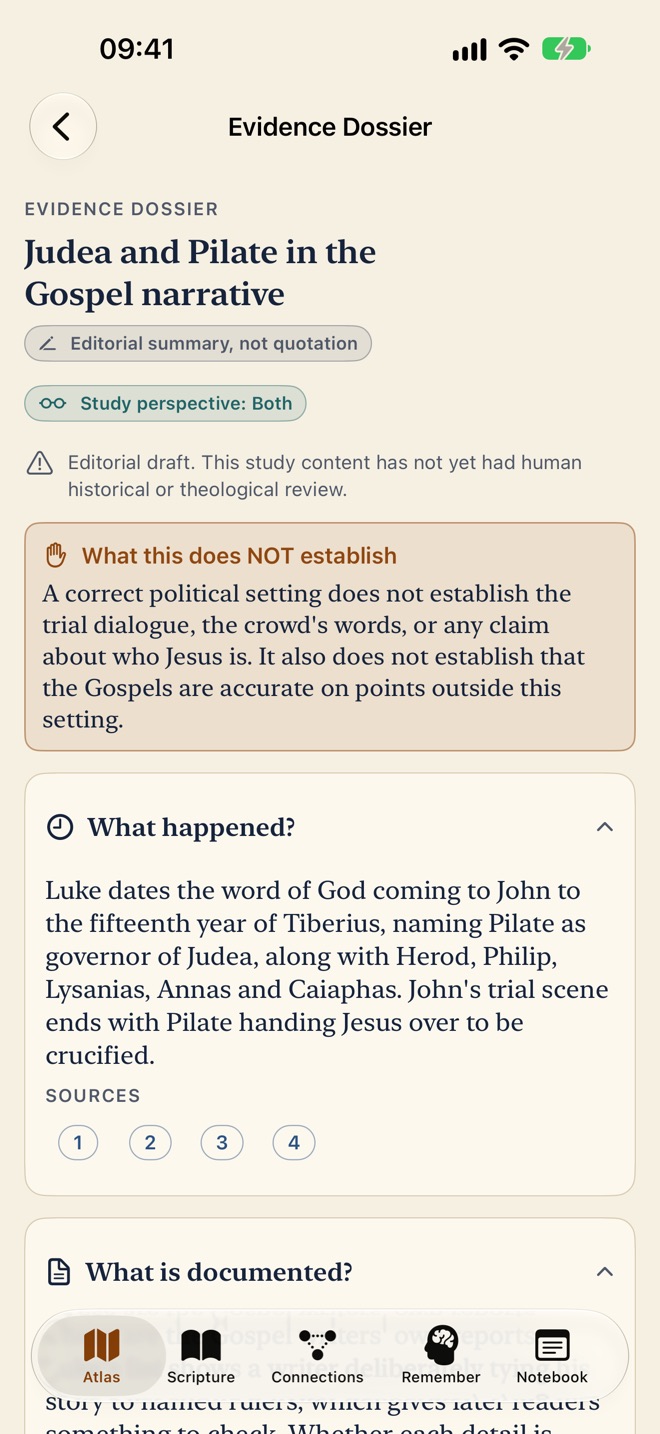
See what a dossier does not establish -
Two clocks: reported date, documented date -
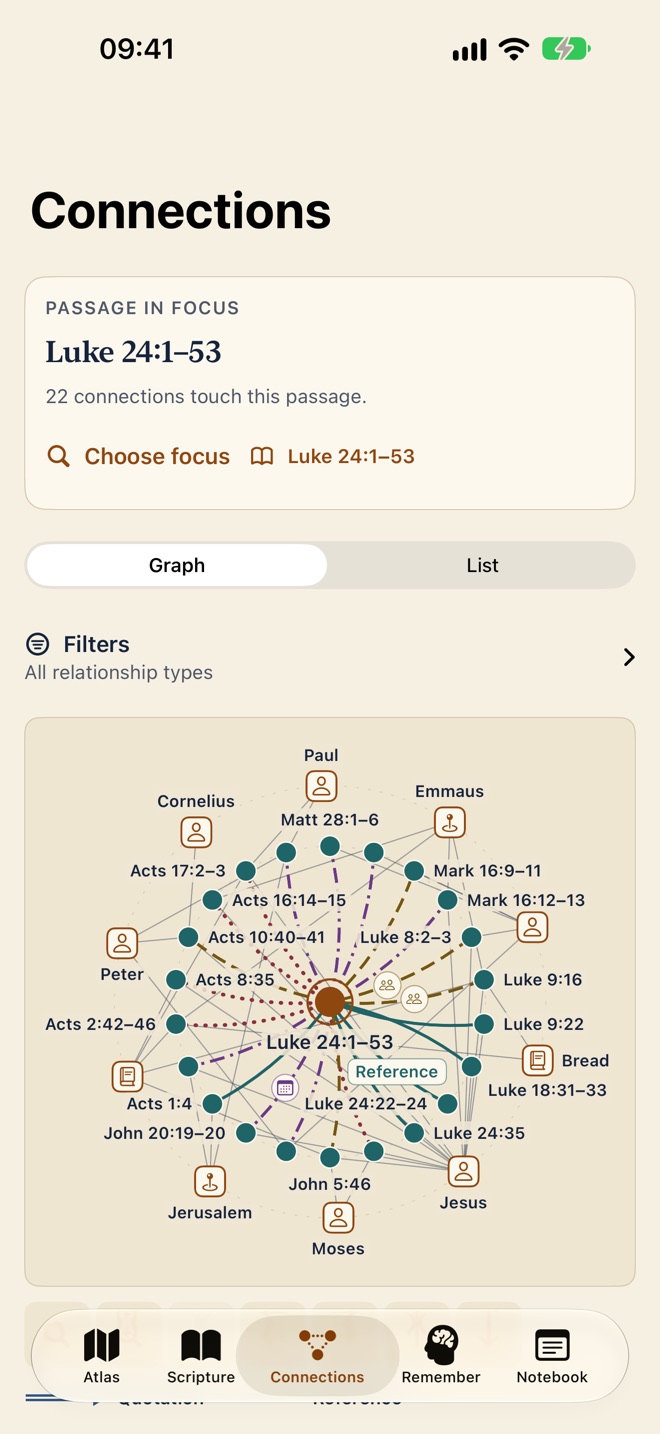
Explore typed links between passages -
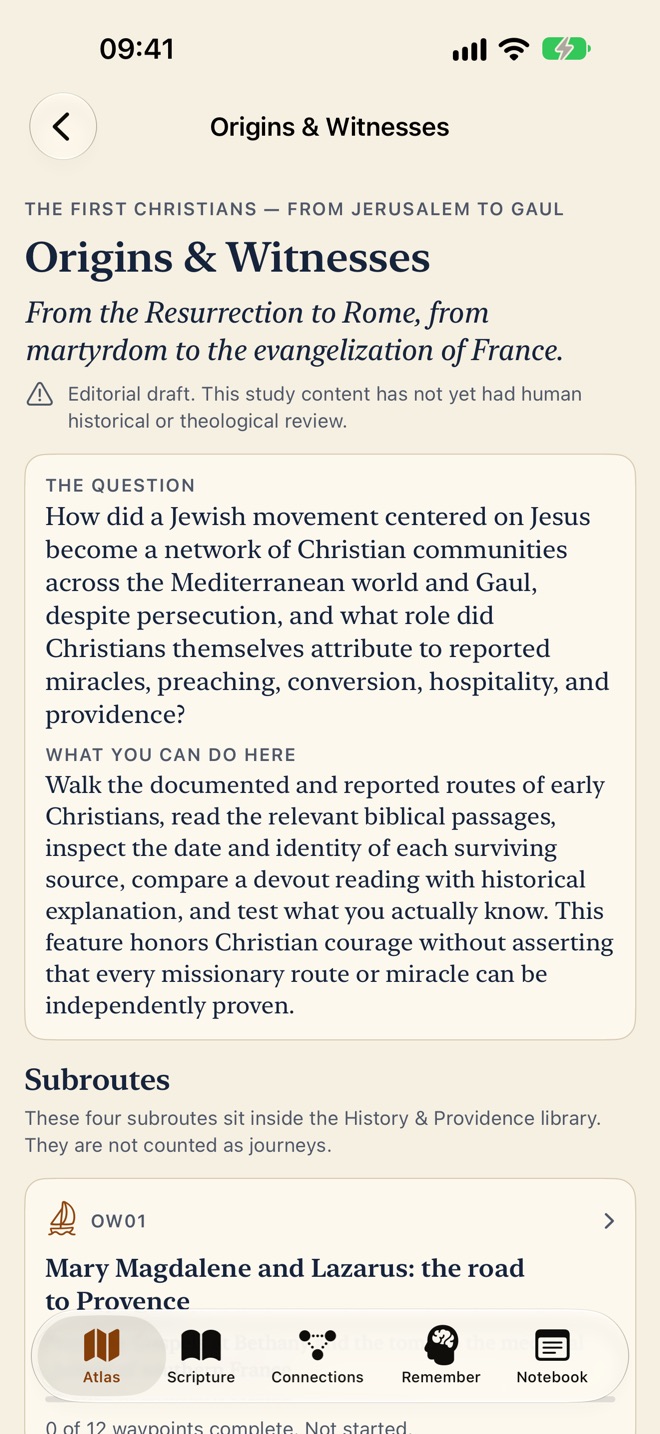
Origins & Witnesses: the first Christians -
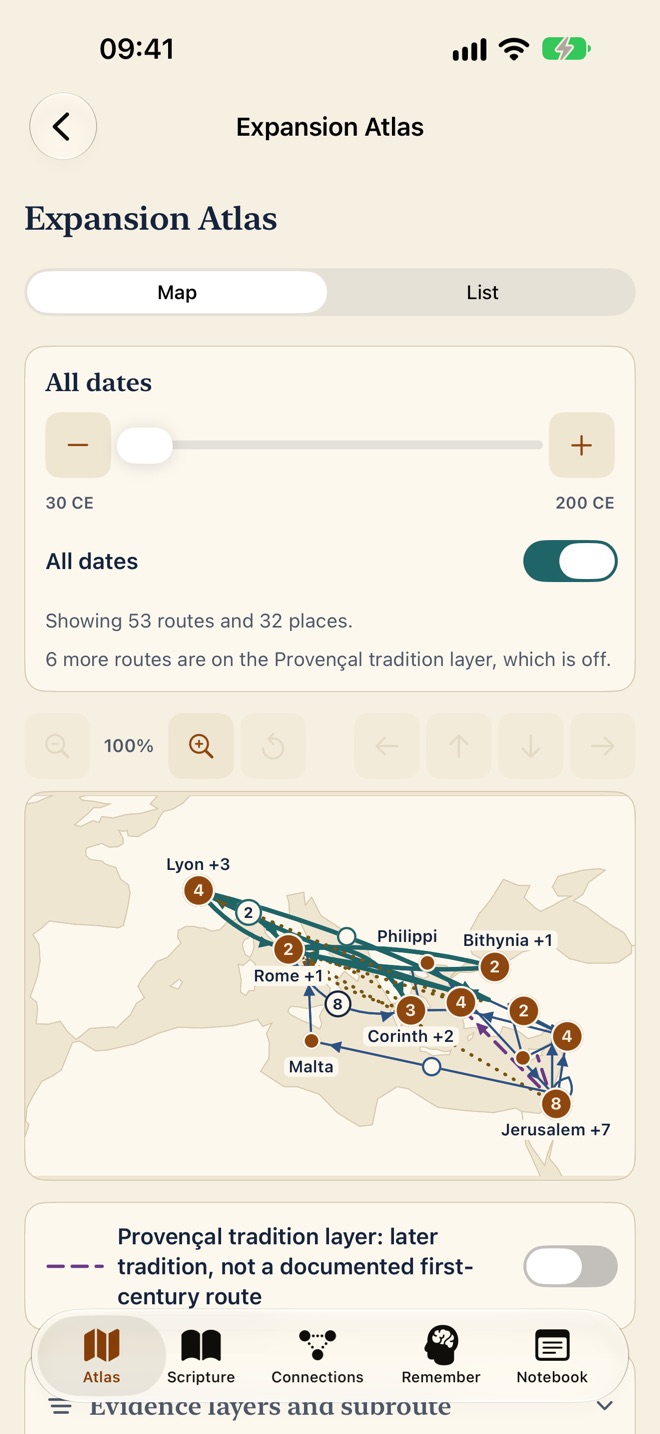
A hand-drawn schematic map with a date slider -
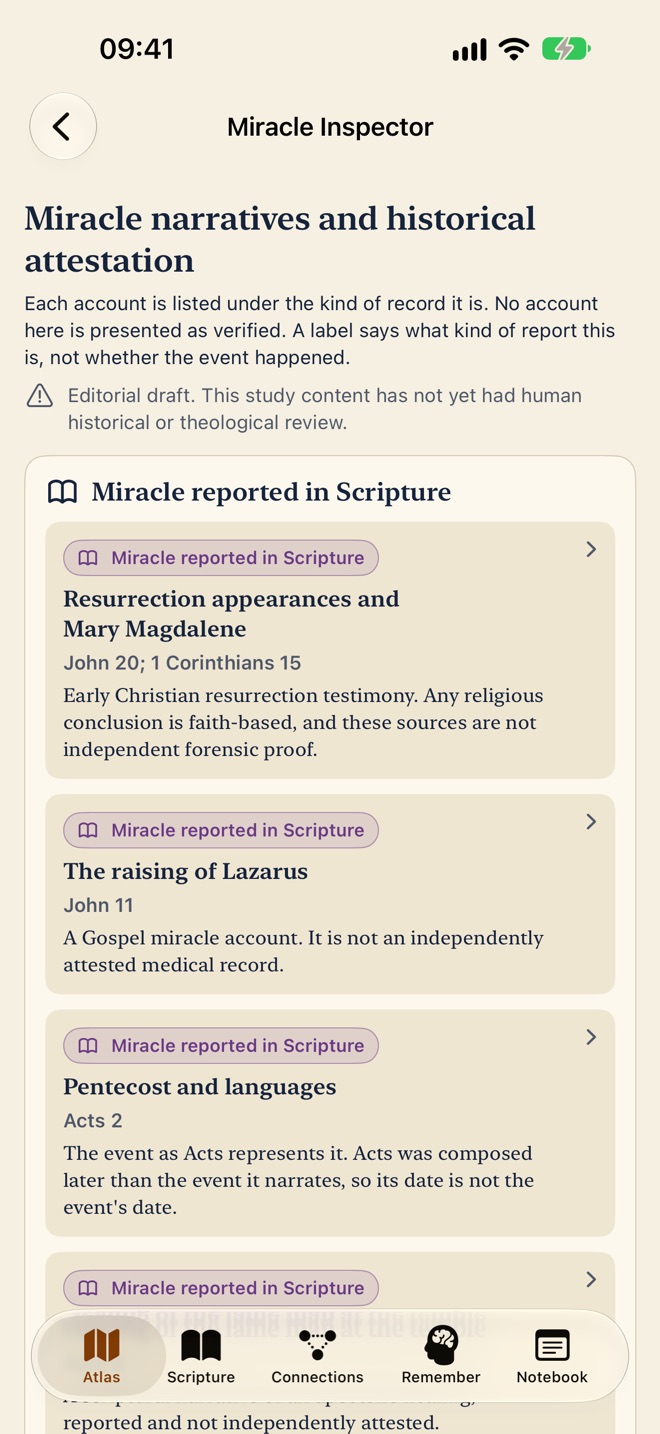
Miracle accounts, labelled by kind of report -
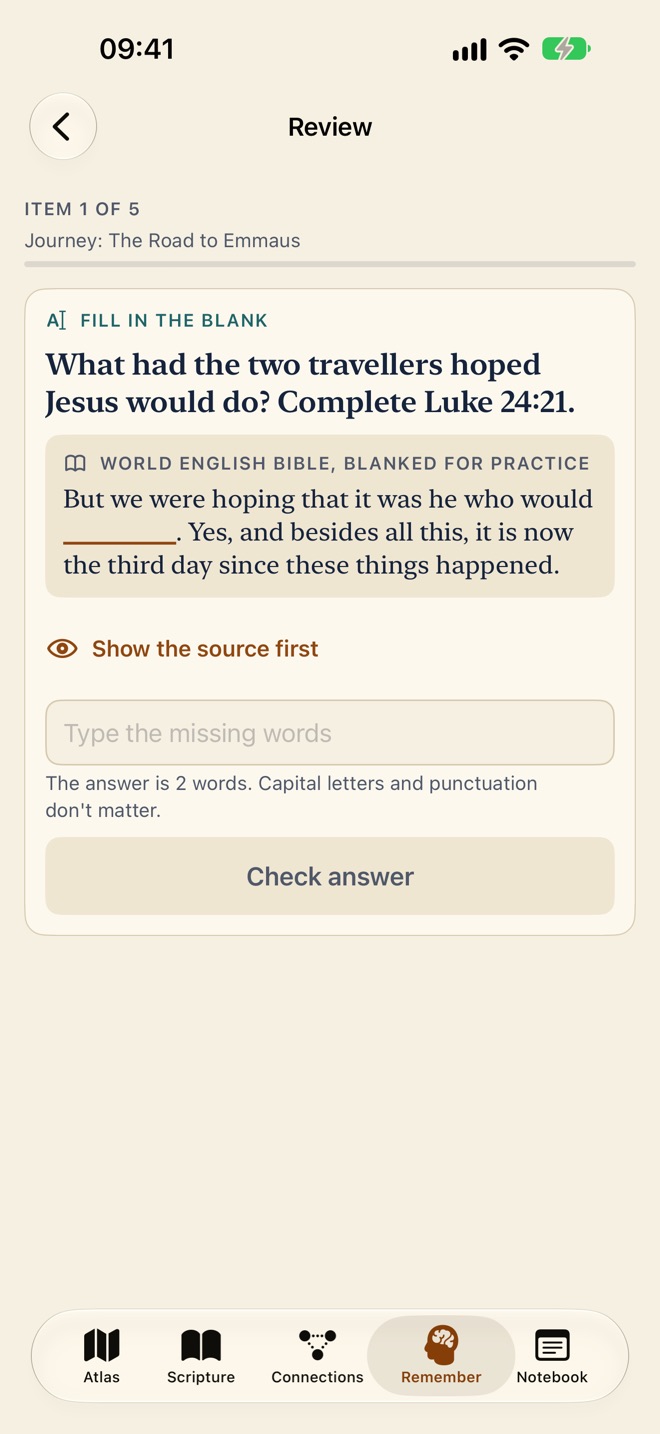
Practise what you read -
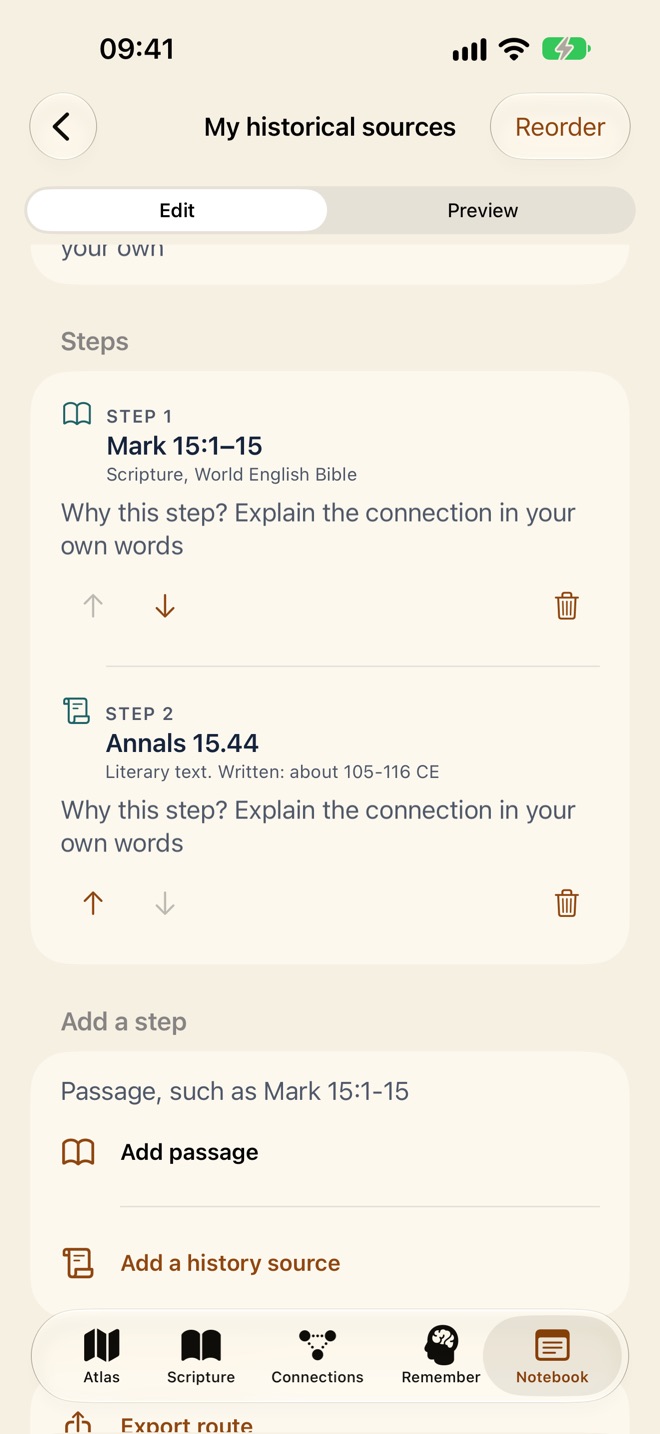
Build a route from Scripture and sources -
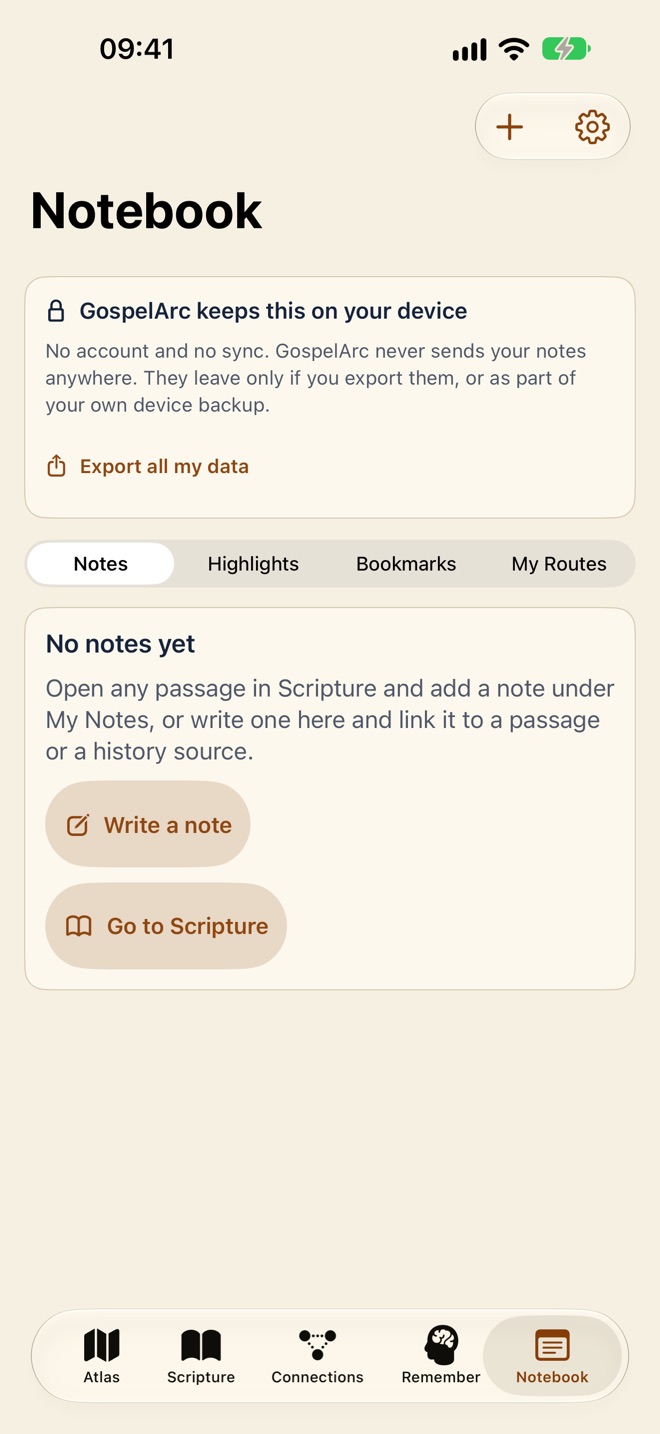
Kept on your device


Status
Where it stands
GospelArc is not finished. This is what is true of the current development build.
-
Not on the App Store
There is no public beta and no release date. Nothing has been submitted to Apple.
-
Study content awaits review
Every journey, dossier, connection, reflection and recall question was drafted by machine. Automated fact-check passes on the newer history journeys found and corrected errors in their drafts. More may remain, which is why people must review all of it: qualified historians, theologians and editors, before release. Sign-offs recorded so far: none.
-
Simulators and one iPhone so far
The app has run in iPhone and iPad simulators, and its automated tests have run on one iPhone. Offline use and accessibility still need hands-on checks by a person.
-
English only
The app, the Bible text and the study content are in English.
-
No price yet
No price has been set, and the publisher has not yet decided what will cost money. In the current build’s code, the only purchase is optional and one-time: it adds 7 Bible journeys and their 63 recall questions, and nothing else needs it. It is not a subscription.
-
Independent
No church, religious institution or Bible publisher has endorsed GospelArc. Apple does not endorse the app or any interpretation in it.